
Pennsylvania law strictly limits law enforcement and military presence at the polls. In general, police officers are not permitted in or near a polling location.
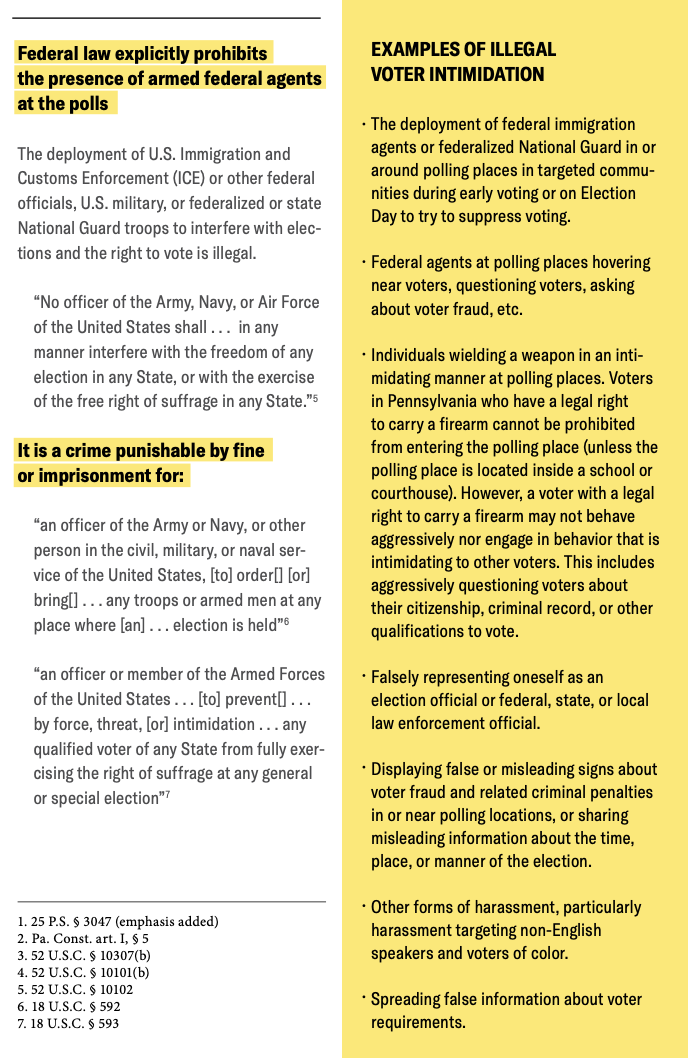
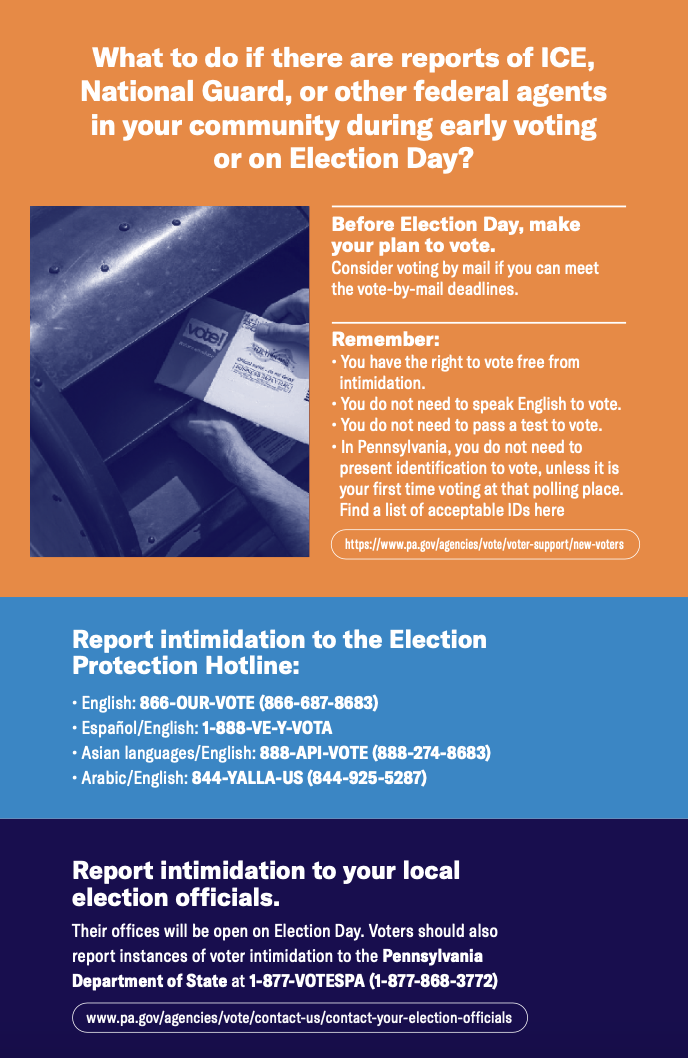
Read this handbook to learn about your rights at the polls — and what to do if they’re violated.

(Feb. 3, 2026) All Pennsylvania children are entitled to a contemporary, effective, comprehensive public education. In his FY27 budget address today, Governor Shapiro proposed $565 million to continue closing the school funding adequacy gap, issuing a clarion call to meet Pennsylvania’s constitutional obligation to adequately fund public education. As the governor therefore recognized, state leaders must continue to respond to the Commonwealth Court’s February 2023 decision declaring Pennsylvania’s school funding system inequitable, inadequate, and unconstitutional.
Two things can be true. First, investments made thus far through the adequacy formula have already begun to deliver real benefits for students across the state, including providing full day kindergarten, expanding mental health programs, increasing afterschool tutoring, and improving access to STEM education and school libraries. The Governor’s proposal to build on this progress and continue the path towards adequacy is critical. Second, despite these investments, schools today remain 3.8 billion dollars underfunded, and the current timeline for compliance is far too slow. Those children who have constantly born the weight of this neglect – low-income children, children of color, and children with disabilities – will continue to absorb the consequences of that failure until this job is completed.
Moreover, the proposed savings from cyber charter reform ($75 million), along withadditional funds for Basic Education Funding ($50 million) and Special Education Funding ($50 million), are critical. But in the upcoming budget process, these investments and savings must be increased to at least the rate of inflation to ensure the adequacy formula functions as intended and to avoid creating new underfunded districts in the process.
Finally, investments must include sufficient funding needed to improve school facilities and expand access to high quality pre-K – both of which the court recognized as key components of a thorough and efficient system of public education.
The General Assembly must build on the governor’s proposal by addressing outstanding needs and accelerating the timeline to close the adequacy gap. A child’s time in school is precious, and Pennsylvania’s public school students cannot afford to keep waiting.
###
The Public Interest Law Center uses high-impact legal strategies to advance the civil, social, and economic rights of communities in the Philadelphia region facing discrimination, inequality, and poverty. We use
litigation, community education, advocacy, and organizing to secure their access to fundamental resources and services in the areas of public education, housing, health care, employment, environmental justice and voting. For more information, visit www.pubintlaw.org or follow on X @PubIntLawCtr.
The Education Law Center-PA (ELC-PA) is a nonprofit, legal advocacy organization with offices in Philadelphia and Pittsburgh, dedicated to ensuring that all children in Pennsylvania have access to a quality public education. Through legal representation, impact litigation, community engagement, and policy advocacy, ELC-PA advances the rights of underserved children, including children living in poverty, children of color, children in the foster care and juvenile justice systems, children with disabilities, multilingual
learners, LGBTQ+ youth, children experiencing homelessness, and children at the intersection of multiple underserved identities. For more information, visit elc-pa.org or @edlawcenterpa on X.
December 26, 2025 – Late in the afternoon on Christmas Eve, in a first-of-its-kind victory for transgender youth and their families, a federal court in Pittsburgh granted a motion to quash a sweeping subpoena issued by the Department of Justice seeking highly sensitive medical records from UPMC Children’s Hospital of Pittsburgh.
Represented by the Public Interest Law Center and the law firm Ballard Spahr, several young patients and their parents urged the court to block the subpoena, arguing that it was issued for an improper purpose, is overly broad, and poses serious harm to the patients involved. The Trump administration sought medical data and personal information related to mental and reproductive health care patients received through the Gender and Sexual Development Program at UPMC Children’s.
While several courts around the country have also halted similar subpoenas, including one in Philadelphia, today’s ruling is the first in a challenge brought by patients. Previous rulings have responded to motions to quash brought by healthcare providers. UPMC did not seek to stop the subpoena.
The court’s order to quash the subpoena prevents the Department of Justice from obtaining the young patients’ records. The court adopted the recent reasoning of a federal court’s decision quashing a similar subpoena to Children’s Hospital of Philadelphia, holding that November decision had “systematically dismantle[d] all of the government’s arguments that healthcare providers should be compelled to reveal minor patients’ personal information, including their names, addresses, social security numbers and complete medical and psychological records.”
In evaluating the subpoena, the court further held that “the government’s demand for deeply private and personal patient information carries more than a whiff of ill-intent.”
“Gender-affirming care is legal in this commonwealth and endorsed by every reputable medical association. The administration cannot use its power to threaten providers and intimidate families. This is a critical win for trans youth and for everyone’s right to medical privacy,” said Mimi McKenzie, legal director of the Public Interest Law Center. “This ruling protects not only our clients but all families who fear that their private lives could be made public by political actors.”
“We are grateful the court recognized the deeply personal nature of these medical records,” said Chesley Burruss of Ballard Spahr. “The court’s ruling reaffirms our clients’ right to seek necessary and legitimate medical care without political interference.”
There is another set of filings still to come in the case. Last week, the Department of Justice agreed to accept allegedly anonymized records, a move patients will strongly oppose on multiple grounds. The court noted its skepticism of the timing of such a concession, but allowed further briefing on the issue on January 16, 2026.
The ruling is available here: https://pubintlaw.org/wp-content/uploads/2025/09/25.12.24-Order.pdf
###
About the Public Interest Law Center
The Public Interest Law Center uses high-impact legal strategies to advance the civil, social, and economic rights of communities facing discrimination, inequality, and poverty. We use litigation, community education, advocacy, and organizing to secure access to fundamental resources and services. www.pubintlaw.org
About Ballard Spahr
Ballard Spahr—an AmLaw 100 law firm with more than 750 lawyers in 18 U.S. offices–has a longstanding commitment to pro bono representation for individuals and organizations in need of legal services, in areas as diverse as civil rights advocacy, legal clinics for veterans in need of wills and other legal documents, and low-income individuals in a spectrum of civil and criminal matters. The firm lawyers and professionals provide more than 50,000 hours annually to ensure that clients have a voice and a legal advocate, regardless of their ability to pay. Visit https://www.ballardspahr.com/about/pro-bono.
November 22, 2025 – In a victory for transgender youth, their families, and their medical providers, a federal court in Philadelphia granted a motion to quash the subpoena issued by the Department of Justice seeking extremely sensitive medical records from Children’s Hospital of Philadelphia.
In June, as one part of a broader attack on the rights of transgender Americans, the Trump Administration sought the medical records of every patient who received gender-affirming care at Children’s Hospital since January 2020. The records being sought were deeply personal, containing medical information about these young patients’ mental, sexual, and reproductive health, along with personally identifying information, including their names, addresses, and Social Security numbers.
Children’s Hospital sought to quash the parts of the subpoena which sought sensitive patient information and their identities. In September, young patients and their parents, represented by the Public Interest Law Center and Ballard Spahr, filed their own motion, urging the court to block the subpoenas, arguing that they were filed in bad faith and invaded children’s right to privacy.
Because the court ruled on Children Hospital’s behalf, it had no need to rule on the motion filed by the patients, dismissing it as moot.
The court found first that the “children’s records concern lawful medical practice governed by Pennsylvania law,” and that the government “lacks statutory authority for a rambling exploration of the Hospital’s files to learn the names and medical treatment of children.”
Next, the court affirmed that the patients’ constitutional right to privacy overrode the department’s interest in obtaining the records, finding that “children’s and their families’ privacy interests in their highly sensitive and confidential medical and psychological treatment in a charged political environment . . . far outweigh” the government’s need for the records
“This is a critical win for everyone who believes healthcare decisions should be made in doctors’ offices, not the White House,” said Mimi McKenzie, legal director of the Public Interest Law Center. “In a sweeping rebuke of DOJ, the Court rejected the government’s overreach and saw its conduct for what it is: an effort to invade the privacy rights of vulnerable children and their parents in order to intimidate them. Our Constitution does not allow that. We are pleased that the rule of law prevailed.”
In its decision, the Court also noted the “wayward reasoning” and shifting rationale of the government throughout the course of the litigation and reminded the government – who at one point suddenly replaced sworn statements in one declaration – that “false statements may be subject to a perjury investigation.”
“Our clients have a measure of the safety and respect they deserve,” said Jill Steinberg of Ballard Spahr. “Transgender kids and their families should know that the law protects them too. For these children and other vulnerable populations, your rights matter, and you do not have to fight these battles alone.”
The court’s ruling follows similar decisions by federal courts in Massachusetts and Washington, where the Trump administration issued the same subpoenas.
Joint Statement from the Education Law Center-PA and the Public Interest Law Center
November 12, 2025 — Today, after a months-long delay, Pennsylvania lawmakers have finally passed a state budget that continues the Commonwealth’s progress toward meeting the funding commitments required under the landmark Commonwealth Court ruling mandating adequate and equitable funding for public schools.
“Lawmakers’ five-month delay in passing this year’s budget left schools, educators, and families in unnecessary limbo and resulted in avoidable harm,” said Deborah Gordon Klehr, Executive Director of the Education Law Center-PA. “But with this budget, lawmakers affirmed that the Commonwealth remains on the path toward a fully and fairly funded public education system. This is another step forward – one that must be followed by continued commitment and sustained investment until every student, in every community, has the resources they need to learn and thrive.”
“The era of one-off, ad hoc education budgets is over,” said Dan Urevick-Ackelsberg, Senior Attorney at the Public Interest Law Center. “This budget shows bipartisan consensus that the march to constitutional school funding is not optional. It took too long, but we moved one year closer to a system that will transform lives.”
This work is far from over. Lawmakers have committed to a path to fully funded public schools, but that constitutional mandate remains years from completion. Getting there will require sustained increases so that schools can provide the resources that matter to students – quality professionals, modern technology, up-to-date curriculum, and safe, appropriate buildings. Pennsylvania must now ensure that these funds reach classrooms quickly and are used effectively to close opportunity gaps and deliver tangible improvements for students.
Lawmakers must also continue with increases in basic and special education funding, enact more meaningful cyber charter school funding reform, fund Pre-K and facilities, and continue to build a public education system that meets the needs of every child, in every community, every year.
By continuing to close the funding gaps that public schools have long grappled with, we move from promise to implementation: from the acknowledgement of something fundamentally wrong, to the actual solution.
